
Heroic Theology
C.S. Lewis's Cosmic Trilogy - Introduction

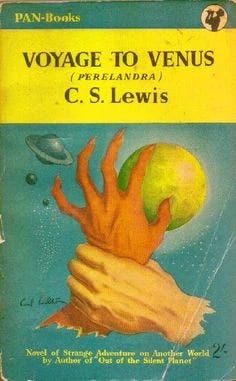
In this series, we’re going to take an in-depth look at C.S. Lewis’s Cosmic Trilogy - those three great novels, Out of the Silent Planet (1938), Perelandra (1942, also known as Voyage to Venus), and That Hideous Strength (1945) - and see how they can help us today if we’re struggling with depression, addiction, or anxiety. These are incredibly rich and multi-layered texts, and there are so many different prisms through which we can view them - literal, theological, mythological, etc. These are all relevant and important, but the point of this Substack is to cut to the chase and ask ourselves, ‘If I’m feeling rubbish and my life’s a mess, how can these books lift me out of this hole and bring me fresh perspectives?’
Personally, I’ve always found these novels tonic and refreshing. There’s something cleansing about them; something clear and sharp. They blow the cobwebs away; like opening a window in a stuffy room. They quicken the mind and invigorate the spirit.
Amongst many other things, I would say that The Cosmic Trilogy is a dramatisation of the central problem of our age - this profound, deep-seated loss of meaning and direction, which we feel on both the individual and collective levels. We have lost our sense of mission and telos. There often seems little point or purpose in what we do. No overarching goal or aim. Just getting by from day to day.
It doesn’t really matter either if we’re materially well-off or not. An abundance of goods can make life easier on the practical level, but it doesn’t solve the core concern. In many ways it makes it worse, a buffer zone of comfort and security that inures us from reality and prompts us to feel that we don’t need anything higher. It’s an imaginative crisis primarily - a crisis of consciousness - not a political or economic one.
Lewis’s notion of the ‘silent planet’ is a helpful symbolic concept here. The creator of the trilogy’s solar system - what Lewis calls the Field of Arbol - is Maleldil the Young. When Maleldil made the planets he gave each of them an ‘Oyarsa’ as a planetary guardian or tutelary spirit. The Oyarsa of Earth - the brightest and greatest of them - became ‘bent’ (evil), desiring Maleldil’s sovereignty and power, and attempting also to spoil and mar His creation. He struck at the moon with his left hand and then tried to invade Malacandra (Mars). War in Heaven ensues, with Maleldil expelling him from the Field of Arbol and binding him in the air of the Earth. Here, the Oyarsa and the eldila (angels) who joined him, have made their headquarters. Earth, therefore, has a particularly unnatural status. It’s enemy-occupied territory essentially, under quarantine and separated from what Lewis calls Deep Heaven. No message comes out of it and it becomes known to the other Oyeresu (planetary guardians) as the ‘silent planet.’ Earth is a fallen sphere, therefore, cut off from the music of the cosmos and exiled from the full life and colour of Maleldil’s creation.
Scaling down from the macrocosmic level to the microcosmic, we can see how this retelling of Lucifer’s fall often maps on to our own mental and spiritual state. When, as it were, our batteries are low, when we’re lacking in vigour and vision, we become prisoners of our own subjectivity and can’t discern anything outside an increasingly narrow frame of reference. We become a ‘silent planet’ in and of ourselves, hedged in by the materialist premises of the modern world, looking for satisfaction and release in the wrong places, and unable to pick a way through the maze.
This is the core difficulty of the world we live in. In denying the sacred, late-modernity bars us from the supernatural nourishment that alone can heal and strengthen us. It can’t accomodate the sacred in its worldview (a mentality which often infects the Churches too), and we’re left scrabbling around for sustenance from a limited range of political, economic, social, and pseudo-spiritual (e.g. ‘mindfulness’) options. None of these will give us what we need. All of them will ultimately push us (as is the Bent Oyarsa’s wish) towards what Colin Wilson called ‘life failure’, a state of mind summed up in W.H. Auden’s poem, It’s No Use Raising A Shout:
Put the car away; when life fails
What’s the good of going to Wales?
Here am I, here are you:
But what does it mean? What are we going to do?
This is the end-game of the world as it’s currently set up - to deprive us of the vertical axis, the axis of Being, and keep us trapped in the horizontal, worldly axis of becoming. ‘Our hearts are restless till they find their rest in thee,’ said St. Augustine famously, but today’s world makes it so hard for us to find and access that divine ‘thee.’ And this is by design, not accident. So, to quote Auden again, what does it mean and what are we going to do? How do we save, bless, and heal this silent planet? How do we break the cordon sanitaire that fences in our minds and keeps us small and tame? How do we rediscover and make fresh contact with the Real?
This is where The Cosmic Trilogy comes into its own. It shows us the degree to which these questions truly matter, and it portrays the universe exactly as it is - not a blank, vacant backdrop of cold and empty air, but a live-action battlefield where the nihilistic and the numinous strive continually for mastery. It’s the literary equivalent of a cold shower, as far from a palliative or an ‘easy read’ as you can get. It’s a violent, disturbing, rapturous and exhilarating summons to war.
There’s a bigger story out there for all of us that’s waiting to be gained and won. Depression, low mood, insecurity, anxiety, all these things - if we could get away from the idea they need to be cured, managed or minimised, and reframe them as calls for help from souls in exile, then we can make them work for us, using them as platforms and fuel for the future, base camps for reclaiming the bigger picture that’s been taken from us.
We have to take at least one concrete, measurable step away from illusion. We have to see, feel, and acknowledge that things aren’t as they should be and that we aren’t as we should be. Like Dante at the start of the Inferno, we come to see that we have lost our way and are stuck in a ‘dark wood.’ The modern world will do everything it can to sing us its siren song and stop us from reaching this point. It will promise us no end of comfort and dopamine hits and instant gratification, spinning a poisonous web of ease and distraction. This is what the Bent Oyarsa’s like. This is what we’re up against. As St. Peter counsels: ‘Be sober, be vigilant, because your adversary the Devil, as a roaring lion, walkers about, seeking whom he may devour. Whom resist ye, steadfast in the faith.’ (1 Peter 5:8)
Elwin Ransom, the chief protagonist in Lewis’s saga, does battle with this enemy - physically, mentally, and spiritually - throughout all three books. The contest is the making of him, because when we first meet him at the start of Out of the Silent Planet, he’s nothing special, just a tall, round-shouldered academic, ‘about thirty-five to forty years of age, and dressed with that particular type of shabbiness which marks a member of the intelligentsia on a holiday.’ The narrator notes a change in him after his trip to Malacandra, but even at the start of Perelandra he’s described a pale and skinny ‘scarecrow’ with increasing amounts of grey hair. In the last chapter, however, he has become a new and much more vital man, plated with muscle and looking ten years younger with a full and pure golden beard. This is due to the intensity of the battle he has fought with evil on Perelandra (Venus) and his subsequent regeneration on that planet’s Holy Mountain.
By the time of That Hideous Strength, he is transformed to an even greater degree. Here he is the ‘Director’ and ‘Pendragon’, whose voice is ‘like sunlight and gold,’ and the grip of whose hands appears inescapable. At the end of the book he does not die and he does not stay the same, but embarks again on yet another transformation. It’s a perpetual growth curve for Ransom, and it can and should be the same for us.
The reason all this happens is because Ransom, like Bilbo in The Hobbit, says no to stasis and yes to adventure. It’s an opening up from the narrow cell of egoic perception to the wide universe of awakened being. We can see then that the way out of nihilism is via a deliberate, focused act of intensity. Just one will do to start with. We have to make the effort and actively choose to see the world as charged with purpose and vitality. The rest will flow from there.
Lewis didn’t like to think of these novels as space stories. There’s no such thing as ‘space’ for him in Deep Heaven - no gaps, no voids, nothing dead and empty - just a living field of vitality, teeming with life and energy. I would suggest then, that if these books are about space at all, they’re about interior space and the rediscovering and reclamation of our inner cosmos.
Our pain and suffering here on the silent planet is therefore far from meaningless. These are the cries of the caged and crippled gods that modernity has made us. What Lewis offers as a counter blast is heroic theology - no sympathy, no ‘poor me’, no sentimentality - a mythopoetic world that’s at once tragic, radiant and terrible. More real than the ‘real world’, tougher and more substantial. He calls us up and out towards a purified core of faith and imagination, to the noble and virtuous fight for meaning, purpose, and value.
The answer to despair is neither cynicism on the one hand nor comfort on the other. It’s transfiguration - always, all the time - and that’s what these books are about.
Next time up, we’ll be taking a deep dive into Out of the Silent Planet.
Until then:
Urendi Maleldil!
PS - I used to write these essays around my full-time work and family life, but I'm not 'working' at the moment as I'm trying to make a real go out of the gift that I believe God has given me in life - writing. I do like a coffee beside me as I write and ponder though, so if you'd like to support the project in this way, please do consider donating via this link. Thank you and God bless you in 2026, John.