
Holy Saturday
Radical Solidarity in the Plundering of Hell

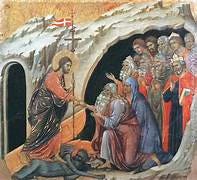
‘I order you, O sleeper, to awake. I did not create you to be held a prisoner in Hell. Rise from the dead, for I am the life of the dead. Rise up, work of my hands, you who were created in my image. Rise, let us leave this place.’
From an ancient homily for Holy Saturday
Holy Saturday feels in many ways like an ‘in-between’ day, and this is no surprise because it is an in-between day and seems, on the surface, to have little interesting going for it. It lacks the power and intensity of Good Friday just gone, and the glory and joy of the Resurrection to come.
But is this really the case? Our inability to see past the surface betrays, I feel, a certain lack of imagination on the part of the modern Christian West. In the Orthodox tradition and in Eastern Catholicism, Holy Saturday has always been a significant day in its own right with its own particular charism or flavour. This is the day when Christ descends into the Underworld, bursts open the gates of Hell, breaks the power of Satan, and releases the spirits in bondage - all the righteous since Adam’s time who have been waiting in patience and prayer for God’s holy light to shine in this darkest recess of the universe.
A fourteenth-century Irish version of the story illustrates this well:
Suddenly, a marvellous ray of light lit up the intense darkness of the underworld. Adam, the father of the human race spoke: “This light,” he said, “is the eternal light. This is the hand of the One who created me.”
Out of the light, Christ answered him: “When I created you, it wasn’t in this place I put you. Return now to your kingdom.”
Then Isaiah spoke: “This is the light of Jesus Christ, the Son of God, “for His light shines upon us.”
Then Simeon spoke to the crowd: “Let us praise Jesus Christ, the Son of God, for His light shines upon us.”
Then John the Baptist spoke: “This is the Son of God. It was of him I said: ‘this is the Lamb of God who takes away the sins of the world.’”
Where Three Streams Meet: Celtic Spirituality, Seán Ó Duinn OSB (Columba, 2000)
Another manuscript of this era, featured in Ó Duinne’s book, describes Christ on Holy Saturday as ‘… a ruddy-flaming huge royal candle, and a red-seething mass of molten metal, wide-showering and immense, on the anvil being hammered, and a splendid, flaring warrior’s dart, and a white-sided, brilliant, cutting moon …’
Clearly the Medieval imagination was highly receptive to this conception of Holy Saturday. It became known in England as The Harrowing of Hell, and The Plundering of Hell in Ireland. We don’t appear to respond so readily in modern times, it seems, and this is a shame and a loss because there’s real value for us today in the dramatic, confrontational manner in which the episode is depicted.
Think of it this way for a moment. Christ descends in might and majesty to the darkest, most troubled parts of our lives - disturbing memories, illicit desires, anger and resentment, pain and numbness - all of that. He brings grandeur, light, and glory, and all those clouds and phantasms that oppress us are sent immediately packing.
The Plundering of Hell is very much worth meditating on, therefore, especially in times of anxiety, distress and consciousness of sin. There is another manner, however, of understanding Holy Saturday in which there is no light or conquest or vanquished foes for anything of that bright and vivid order. It’s the Descent Into Hell in passive mode rather than active. It comes to the same thing though - solidarity and redemption in the depths of darkness when structure and meaning have dissolved and everything feels lost and broken.
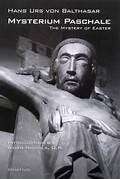
This theology was notably developed by the theologian, Hans Urs Von Balthasar (1905-1988) and his friend and collaborator, the mystic, Adrienne Von Speer (1902-1967). In works such as Balthasar’s Mysterium Paschale (1969) they articulated an understanding of Holy Saturday in which precisely nothing (and yet paradoxically everything) happens. Christ’s sufferings do not end when he breathes his last on the cross. There are further levels to go, levels of sheer nothingness and utter deadness. Christ, in this reading, is completely and fully dead in the tomb. He isn’t preaching or healing or even laying down His life any more. That’s all over and done with. He’s not doing or saying anything at all now. He’s still, silent, and cold. He’s entered 100% into the realm of death, a zone of total abandonment and God-forsakenness. It’s an ‘after meaning’ kind of space, not unlike a Samuel Beckett play or novel (e.g. Endgame or Malone Dies), where language collapses and any sense of pattern or purpose vanishes into the void. The lights go out, and there’s no plan, no vision, no future, and no hope.
Yet this is the way it has to be. ‘We must not skip over Holy Saturday,’ as Balthasar says, ‘and the fact of a dead Christ.’ By descending to such depths, the creative Logos - who makes and sustains all that is good - baptises and makes holy the very worst states of mind and being a human can inhabit. No matter how far we feel ourselves at times to be from God, we can be assured now that He has gone further. If we end up in a vegetative state one day, well, He knows what that’s like too. In a psychotic state, He has been there. In a deluded state, He has been there. In a traumatised state, He had been there. If we lose our reason, if we fall unconscious - all these things that can happen - He has been to every single one of these places. Nothing is foreign to Him. He has been there. He knows.
It sounds grim, to say the least, but in reality it’s just another facet of the Good News. Truth is a big thing indeed and it manifests in different keys and modalities. Both modes of Christ’s Descent - active and passive, raucous plundering and sepulchral stillness - reveal the great truth that whatever we do, wherever we go, Someone has gone there before us. There’s nowhere we can be that He isn't. He’s left his mark on everything, and that’s why we can turn to Him with confidence in any and every circumstance.
This is the message of Holy Saturday. It’s never too late and we are never alone. We are held and watched over, and the demons that torment us have no objective power. That was taken from them by Christ in The Plundering of Hell. There is no truth or reality to to them any more, if they ever had any in the first place. They are parasitic on the Good. That’s all they are now. This is what the Lord exposes and brings to light this day. He is, as David Jones shows us in The Anathemata, ‘That which the whole world cannot hold, Atheling to the heaven-king, Shepherd of Greekland. Harrower of Annan. Freer of the waters. Chief physician and dux et pontifex.’
Thank you for reading. If you’d like to support me further, my new e-book, Guardians of Presence: Uncovering the Sacred in a Time of Deep Forgetting is available here.
You can also ‘Buy me a Coffee’ here.
Thanks again and all the very best for Easter and beyond,
John.
I loved the way that you hold two vastly different conceptions of an event side by side without pitting them against each other. So refreshing.
Balthasar’s view, as you've elucidated it, reminds me of this Paul Tillich's words:
"The vitality that can stand the abyss of meaninglessness is aware of a hidden meaning within the destruction of meaning."
Thanks very much 👍 Yes, the same phenomenon can have very different modes or aspects. Different ways of expressing itself. Or it appears differently to different people. But they all lead to the same place. I think this polyphonic way of seeing things is particularly hard for the modern mind to grasp. Today it's like, "It's got to be 'this', and if it's not 'this' it's 'that', and one necessarily excludes the other." A limited, binary way of perceiving reality.
The older I get, the more I'm becoming drawn to 'dark night' style theology. I'm not a deconstructionist in any way though. I believe very much in form, order, pattern, hierarchy, etc. I just think we often have a very limited view of what these things are. It's our all too often petty, small time, 'bourgeois' conceptions that need breaking down and blasting through. It can feel like the end of the world when that happens, but in truth it's only the beginning.