
Our Proper Dark
Yeats - The Statues

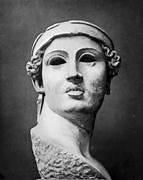
What a tremendous poem this is! Robust, hard-hitting, and intense. A real power-pack. 32 lines of concentrated imaginative force:
Pythagoras planned it. Why did the people stare?
His numbers, though they moved or seemed to move
In marble or in bronze, lacked character.
But boys and girls, pale from the imagined love
Of solitary beds, knew what they were,
That passion could bring character enough,
And pressed at midnight in some public place
Live lips upon a plummet-measured face.No! Greater than Pythagoras, for the men
That with a mallet or a chisel” modelled these
Calculations that look but casual flesh, put down
All Asiatic vague immensities,
And not the banks of oars that swam upon
The many-headed foam at Salamis.
Europe put off that foam when Phidias
Gave women dreams and dreams their looking-glass.One image crossed the many-headed, sat
Under the tropic shade, grew round and slow,
No Hamlet thin from eating flies, a fat
Dreamer of the Middle Ages. Empty eyeballs knew
That knowledge increases unreality, that
Mirror on mirror mirrored is all the show. When gong and conch declare the hour to bless
Grimalkin crawls to Buddha’s emptiness.When Pearse summoned Cuchulain to his side.
What stalked through the post Office? What intellect,
What calculation, number, measurement, replied?
We Irish, born into that ancient sect
But thrown upon this filthy modern tide
And by its formless spawning fury wrecked,
Climb to our proper dark, that we may trace
The lineaments of a plummet-measured face.
There’s a lot to unpack here, and a lifetime’s worth of dense, rich, evocative wordplay to meditate on. But for the purposes of this essay, we’re just going to focus on the first and last stanzas. That’ll be plenty for today, and a wider understanding will flow out naturally from there.
We begin with those timeless statues of Greek antiquity, fashioned according to the mathematical principles set down by Pythagoras and his followers. Pythagoras recognised that anything we make or create here on Earth can only have being and significance if it is informed and infused by the heavenly pattern that upholds the created order, both seen and unseen. Such harmony and structure – such grand alignment with the moving power of the universe (‘the love which moves the sun and the other stars’ as Dante describes it) – stands at the antipodes of the ‘filthy modern tide’ that’s taken a wrecking ball to the ‘plummet-measured’ faces of the ancient statues and the Divine power that made them shine and gleam.
This potency is recognisable to anyone – poet, lover, rebel, mystic – who dares to look upwards and is inspired, even if in distorted fashion, to climb up to that ‘proper dark’ and look upon and be at one with the sacred pattern. You don’t have to be a great intellect or lose yourself in meditation or the pursuit of empty knowledge, where ‘mirror on mirror mirrored is all the show.’ Sometimes lovesick teenagers know best. ‘Boys and girls, pale from the imagined love of solitary beds.’ They know what the statues are. They know what Pythagoras is about.
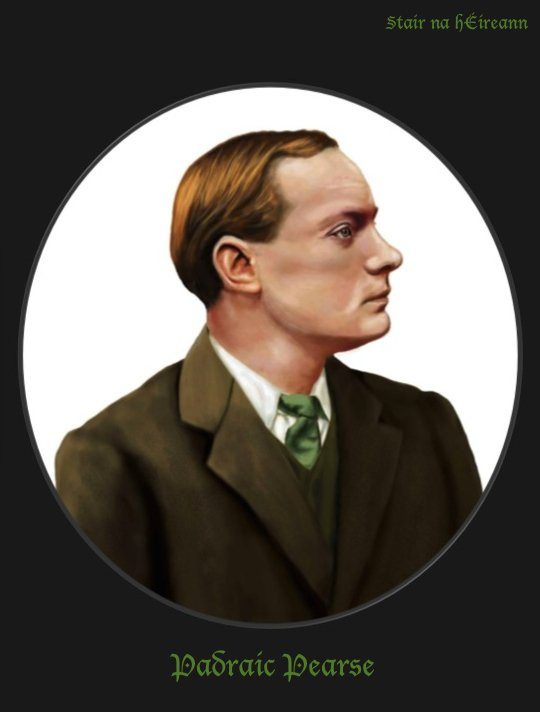
Padraig Pearse (1879-1916) was one of these dreamers who intimately understood the divine texture at the heart of things and how that spoke to the destiny of his homeland and people. A band of Irish rebels, led principally by Pearse, struck mightily against the British state and occupied the General Post Office in Dublin on Easter Monday, 1916. The Easter Rising, as it was called, brought a depth charge with it of archetypal power and force. It ended in bloodshed and death and apparent failure, yet just six years later Ireland had achieved a degree of freedom unthinkable in early 1916.
Pearse was deeply versed in this Platonic, mythopoetic mode of thinking. When he invoked the mythical hero Cuchulain as a symbol of Irish resistance, he made that ancient Gaelic champion a dynamic, live-action reality again. Cuchulain stalked indeed ‘through the Post Office’ and gave an extra, mythic edge to what otherwise might just have been another routine political uprising.
The sacred is real. This is the point. It doesn’t come to order – it comes in its own way and time – but it can be tuned into, it can be aligned with, it can be invoked, and it can and will change the direction of culture and society. Even now. Even in this desecrated, disenchanted age. Especially now, in fact. The sacred calls to us out of the darkness, and in many respects it needs our participation as much as we need its presence. Modernity has made ourselves and the sacred star-crossed lovers, but we are still supposed to be together, building and creating, dancing and playing at the heart of the world God made. But we need first of all to relearn the arts we have lost – how to see, hear, think, and feel on a level that’s at once higher and deeper than the restricted range of consciousness that supposedly represents ‘real life.’ Contact will be remade from here.
We have to reject, therefore, all manifestations of ‘formless spawning fury’ and return to ourselves, climbing back to our ‘proper’ creative dark, where there’s silence and receptivity, an absence of noise and glare, and where the ‘still small voice’ of the sacred – shy and elusive as it is – can speak and sing and make itself heard and known in the depths of our being.
This is an edited version of Chapter 7 of my recent e-book, Guardians of Presence: Uncovering the Sacred in a Time of Deep Forgetting. The book is available here.
You can also ‘Buy Me a Coffee’ here.