
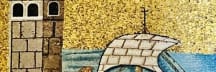
Ratzinger on Venus
The Vision on the Holy Mountain


In the last chapter of Perelandra, high up on Venus’s Holy Mountain, Ransom has an extraordinary vision of cosmic wholeness and integrity - the luminous pattern that underpins the created order:
He thought he saw the Great Dance. It seemed to be woven out of the intertwining undulation of many cords or bands of light, leaping over and under one another and mutually embraced in arabesques and flower-like subtleties.
It’s a vision of continual creation, a perpetual new beginning where everything is fresh and newly-minted. It’s dynamic and interlinked - bright, glorious and resplendent.
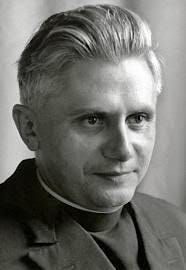
It also calls to mind for me some of the key themes in the life and work of Joseph Ratzinger (1927-2022). As Pope Benedict XVI (2005-2013), he often reflected on these twin motifs of light and creation. For Ratzinger, they come as a pair, and without them nothing good can happen. We just wouldn’t have the stage. As he explained in his Easter homily of 2012:
‘Light makes life possible … To say that God created light means that God created the world as a space for knowledge and truth, as a space for encounter and freedom, as a space for goodness and for love. Matter is fundamentally good, being is good.’
So far so good then. The world is a bright field of wonder and potential. But Ratzinger doesn’t stop there. He is the Christological theologian par excellence. Nothing is abstract for him. Everything is personal, and it all points back to the person and presence of Christ. It isn’t just that Christ makes or sends the light and the world is thereby created. He Himself is that light, and the Resurrection is the first day of creation all over again but in a higher octave:
‘Now it is the first day once again - creation is beginning anew. “Let there be light,” says God, “and there was light.” With the resurrection of Jesus, light itself is created anew, He draws all of us after him into the new light of the resurrection and he conquers all darkness. He is God’s new day, new for all of us.’
Lewis is like this as well. He too is a deeply Christological thinker. We see this most clearly in Narnia, of course, with the strong correlation between Aslan and Our Lord. But it’s there in The Cosmic Trilogy too, if less obviously stated. Maleldil is the Christ figure’s name here. He is the central point and fulcrum - the unmoved mover, the Pole Star, the still point of the turning world. The Dance revolves around Him. He is centre and circumference and everywhere at once:
‘Where Maleldil is, there is the centre. He is in every place. Not some of Him in one place and some in another, but in each place the whole Maleldil, even to the smallness beyond thought. There is no way out of the centre save into the Bent Will which casts itself into the Nowhere. Blessed be He!”
Ransom is taken up into the white hot core of creation - its complexity, expansiveness, and limitless interconnectivity. Yet the vision never becomes cluttered and convoluted. Ultimately it leads away from complexity - through and beyond it - to a place of radical simplicity and peace:
He went up into such a quietness, a privacy and a freshness that at the very moment when he stood farthest from our ordinary mode of being he had the sense of stripping off encumbrances and awaking from trance, and coming to himself. With a gesture of relaxation he looked about him.’
Ratzinger’s theology is very much in this spirit. He is constantly profound, yet never anything else than simple, clear and lucid in his exposition. Where there is fragmentation and dispersion, he brings unity and focus. As Lewis does himself, of course.
Unity in diversity. Full focus on Maleldil. Resurrection and creation shining in the splendour of an always expansive, always simple, always new beginning.
Thanks Thos 👍 That sounds a really interesting book! I don't have any opinions on black holes unfortunately though. I don't have any kind of scientific mind and have very little interest or knowledge in such matters. I will say though that a day will come when spriritual and scientific knowledge will be as one again in a unified, coherent whole. The work of people like Rupert Sheldrake and Iain MacGilchrist points in this direction, I think. This split that we've suffered from for the last few hundred years is unnatural and an aberration and a symptom of a society that has lost its metaphysical moorings. I'm a victim of that mentality in my own way as much as the likes of Richard Dawkins on the other side. A better future is on its way though. I can see it coming - on the other side of Heidegger's 'Another Beginning' ☀️
Excellent work as always John, a fusion of two of my favourites, what do you think of black holes? I was reading “Mythological sources in the Lord of the Rings” by Mitchell Beazley the other day and where he was discussing Tolkien’s creation mythos and the disharmony in the music of creation caused by Melkor, it made me think of black holes as a sort of satanic light consuming tear in the harmonious and light bearing fabric of God, I wonder what Lewis would say of them and Ratzinger too.