
Where Life Begins
C.S. Lewis's Cosmic Trilogy - Perelandra

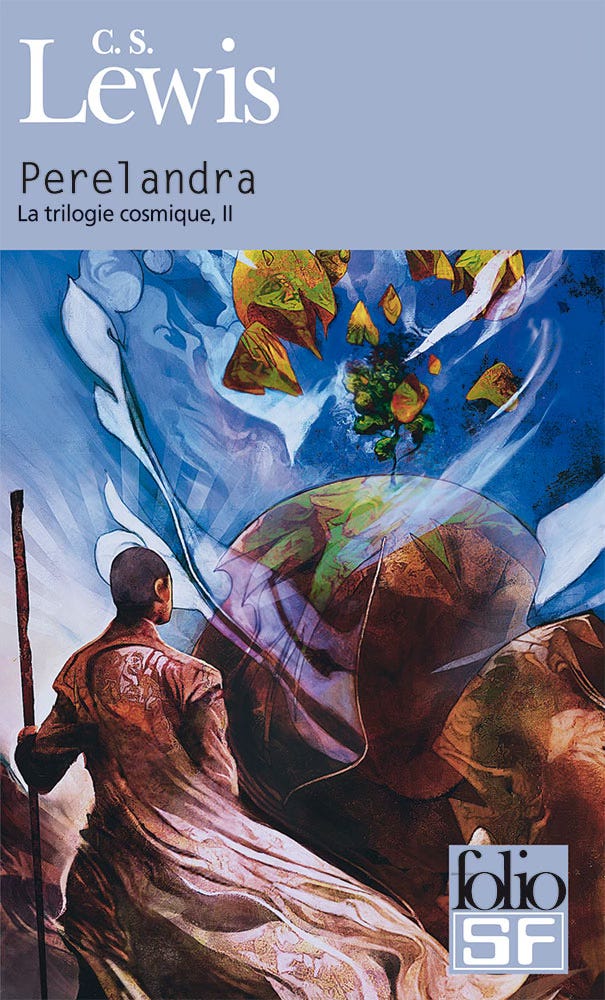
The first thing I’d say about Perelandra is that it’s an absolute joy to read. The prose is revelatory - like music, fire, and water - crystal clear and sharp as a tack, yet as fluent and fluid as a bath of liquid gold. Lewis must have had access to some Deep Mind when he wrote it. Either that or the planetary gods - the eldila - wrote it through him. Whichever it is, the result is outstanding.
Maleldil, through the agency of the Oyarsa of Mars, sends Ransom on a mission to Perelandra (Venus) to thwart an imminent attack from the fallen Oyarsa of Earth. He isn’t told any more, but slowly starts to see that he’s been sent to prevent the Fall of the first Venusian man and woman. For this is a very young world in comparison to our own or to Malacandra (Mars), which is older still. Perelandra, after aeons of preparation, has only now been made ready for human habitation. The story of Adam and Eve is about to be played out again, and though an immeasurable Good came into our world as a result of the Fall - the incarnation of Christ - it is not in Maleldil’s design for it to happen here. This is why Ransom has been sent.
C.S. Lewis himself is the narrative voice behind The Cosmic Trilogy. He presents himself as a friend of Ransom’s, and it is to Lewis that Ransom recounts his experiences on both Mars and Venus. Perelandra begins with Lewis leaving the train station at the fictional town of Worchester and setting out on the three-mile walk to Ransom’s cottage. He is responding to a telegram from his friend, which simply says, ‘Come down Thursday if possible. Business.’
The walk turns into a terrifying mental and spiritual ordeal. Lewis knows that Ransom is likely to have summoned him in connection with the eldil of Malacandra, and the thought of encountering this unearthly being terrifies him. All kinds of thoughts and imaginings start rampaging through his mind. The creatures on Malacandra that Ransom had previously told him about now seem not so much a cause of wonder as totally monstrous and inimical to humankind. He even starts to suspect that Ransom is in league with these aliens and is plotting some act of combined evil against the world.
Ransom later tells Lewis that this imaginative assault emanated from the fallen eldila of our world, who were doing their utmost to bully Lewis into returning home. They know that Ransom has asked Lewis to help him prepare for his salvific mission to Venus, and it’s in their interests that the Fall takes place there as well as on Earth. But Lewis is privy to this at the time, and this is instructive for ourselves today - as readers and as pilgrims through life - in that so many of the oppressive thoughts and emotions that weigh us down might not come from ourselves at all but from external negative forces.
This is actually quite a liberating concept in that it shows us how much we matter. Age-old powers of evil will invest time and effort in driving us from the path that leads to God. It’s also encouraging to think that we therefore aren’t anything like so inclined to evil and disorder as we sometimes think. In this respect, we are not wholly unlike the Green Lady whom Ransom meets shortly after his arrival. She is beautiful, innocent, and pure, but untried and untested and very much susceptible to the machinations of evil. The planet itself reflects her archetypal luminosity:
He opened his eyes and saw a strange heraldically coloured tree loaded with yellow fruits and silver leaves. Round the base of the indigo stem was coiled a small dragon covered with scales of red gold. He recognised the garden of the Hesperides at once … He remembered how in the very different world called Malacandra - that cold, archaic world, as it now seemed to him - he had met the original of the Cyclops, a giant in a cave and a shepherd. Were all the things which appeared in mythology on Earth scattered through other worlds as realities?
It is this beauty, this latent glory, that Weston, the demented scientist of Out of the Silent Planet, has come to spoil. In truth, he did not so much ‘come’ as was ‘sent’ by the Bent Oyarsa of Earth. Weston has turned himself away from light and goodness for so long that he has become an empty vessel and a conduit for evil and later on becomes fully possessed.
There is another human being on the planet - the man the Lady refers to as the King. They were together once, but have now been separated:
‘If you mean the King, I have already told you that I do not know where he is. When we were young - many days ago - we were leaping from island to island, and when he was on one and I was on another the waves rose and we were driven apart.’
The geography of Perelandra is made up to a large extent of a series of islands that float and undulate on the sea. There is also the Fixed Land, and this is more like the various land masses we inhabit on Earth. For a reason known to Himself alone, Maleldil has forbidden the King and Queen from spending a night, alone or together, on the Fixed Land. They can spend as much time as they like there during the day, but they are not to remain at night. This is the command that Weston - or the power behind Weston - is determined that the Lady should disobey.
A long battle of words, unfolding over the course of several days, now ensues, with Weston persuading, cajoling, and employing every trick in the book to sweet talk the Lady into disobeying Maleldil. Ransom does his best in his counter arguments to keep her true to her Creator. But after Weston is possessed - after he becomes the ‘Un-Man’ - his task becomes much harder as the Un-Man is able to talk all night and illustrate his points with stories and fables that speak directly to the Lady’s subconscious mind.
‘This can’t go on,’ Ransom keeps on thinking, yet he is at a loss as to what to do until it becomes appallingly clear that what he has been sent to do is physically kill the Un-Man. There’s no other way. He tries to worm his way out of the situation, begging and pleading in the darkness of the night for Maleldil’s representative to show up and save the day. After all, the Bent Oyarsa has sent his own representative, who is now on the brink of instigating the planet’s Fall. But Ransom is Maleldil’s representative, and as he comes to realise, it’s all on him:
Only the actual was real; and every actual situation was new. Here in Perelandra the temptation would be stopped by Ransom, or it would not be stopped at all … This chapter, this page, this very sentence in the cosmic story was utterly and eternally itself; no other passage that had occurred or ever would occur could be substituted for it.
This whole inner dialogue lasts the entirety of Chapter 11, and it’s an essential read for any of us struggling to make a big decision in life or perform some necessary task which we don’t feel equipped to do. Ransom has to dig deep and go beyond himself. There’s something quite Nietzschean about the self-overcoming that takes place here, but Ransom doesn’t get where he does through force of will. He’s not an Übermensch in this sense. Though he appears to be alone, Maleldil is present throughout and Ransom is guided by His voice at critical moments. He has the good sense and humility to listen, trust, and act in accordance with that greater Will.
Anything that we achieve, therefore, any growth that we undertake, is never down to our own merits and strength. Deep-seated, long-lasting, meaningful change can only be set in motion through partnership with the Divine. If we work with Maleldil and tune into what He’s saying, then we’ll find ourselves ascending the ladder of Being as Ransom does. But if we think we can change our lives and change the world by ourselves then we’ll end up like Weston - puffed up with pride and prey for the demonic.
By the end of Chapter 14 the Un-Man is dead and Ransom has passed through his ordeal. The vicissitudes of the fight and ensuing chase over land and sea and beneath the Earth leave him stuck in a subterranean realm of passages and caves, too battered and weary to do anything more than walk in a straight line:
And so, after more strangeness and grandeur and labour than I can tell, there came a moment when his foot slid without warning on clay - a wild grasp - a spasm of terror - and he was spluttering and struggling in deep, swift-flowing water … He lay helpless, in the end, rushing forward through echoing darkness. It lasted a long time … A moment later and he was rushed out into broad daylight and air and warmth, and rolled head over heels, and deposited, dazzled and breathless, in the shallows of a great pool.
Ransom rolls out onto a patch of turf, and here, for the next few weeks, he is nursed back to health and vitality by the planet itself, alternating between sleep and the eating of a grape-like fruit which grows nearby. Eventually, he is able to explore and to climb the great mountain that he sees in the distance. He enters into a flow state as he ascends:
He was not lonely nor afraid. He had no desires and did not even think about reaching the top nor why he should reach it. To be always climbing this was not, in his present mood, a process but a state, and in that state of life he was content.
But he does reach the top, and there he meets the eldila of Mars and Venus - Malacandra and Perelandra - and the Lady once again, now reunited with the King. A host of animals are present too, and there’s a shimmering, numinous sense of wonder, joy, and holy awe. The life of Perelandra can now properly begin, without a Fall to contend with or any need for rescue or salvation. This is how it should have been on Earth, and this is how it will one day be in the future:
‘But in the end all shall be cleansed, and even the memory of your Black Oyarsa blotted out, and your world shall be fair and sweet and reunited to the Field of Arbol and its true name shall be heard again.
Many things are here revealed to Ransom (and to ourselves) concerning the nature of reality and the presence and activity of God. He is granted an experience of ultimate truth and meaning, where …
… complexity was eaten up and faded, as a thin white cloud fades into the hard blue burning of the sky, and a simplicity behind all comprehension, ancient and young as spring, illimitable, pellucid, drew him with cords of infinite desire into its own stillness. Ransom went up into such a quietness, a privacy and a freshness that at the very moment when he stood farthest from our ordinary mode of being he had the sense of stripping off encumbrances and awaking from trance, and coming to himself.
This sentence sums up Perelandra and the impact it makes on us. It strips off our encumbrances, wakes us up from trance, leads us back to ourselves, and guides us to a place of light, radiance, and peace. Through self-doubt, trial, temptation, and mental, physical, and spiritual warfare, it lifts us up into a clear, luminous sphere where only the Good is real. It calls us back to Truth and Being, to a Beauty which we know deep down is the only reality there is, but which the conditions of the modern world make it all but impossible at times to see.
Perelandra turns the tables on this. It brings us back home to the Real and shows us that there are more and greater things in God’s design - for ourselves and for the cosmos - than we have been permitted to perceive, and it prepares and shapes us for even more demanding and essential contests still to come.
It is! It's just superb that sequence, from when Ransom throws the Un-Man into the fire until the end of the book. I don't think I've read anything better, ever. That said, there are some great sequences in That Hideous Strength too and we'll be having a look at them next week 👍
Excellent series so far thanks mate, very helpful. The last part of this book is breathtaking, the portion atop the Holy Mountain where we get all Manner of cosmological theories about planets, the gods and titular spirits amongst other things like speculation on Angelology, left me wanting more!