
Communio Sanctorum
The Seven Friends of Narnia

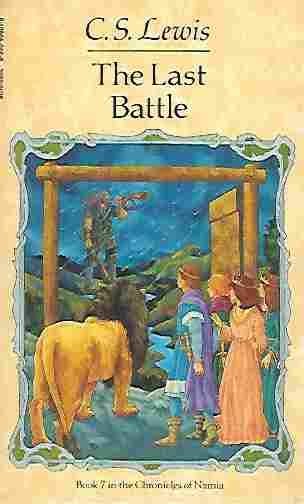
In my previous essay, Susan's New Start, I delivered a dressing down to the Seven Friends of Narnia - Digory, Polly, Peter, Edmund, Lucy, Eustace, and Jill - for their catty response concerning Susan’s (temporary, we trust) exclusion from Aslan’s country. So, in the spirit of charity shown to Susan last time out, I’d like today to redress the balance a bit and give some credit where credit’s due.
The scene we’ll focus on likewise takes place in The Last Battle, this time at the end of Chapter Four. Tirian, King of Narnia, becomes the victim of a coup d’état. He is tied overnight to the trunk of a tree, awaiting further punishment. He reflects in the dark and cold on those episodes of Narnian history which we already know from The Silver Chair, Prince Caspian, and The Lion, The Witch, and The Wardrobe. In these stories, he recalls, at times of great crisis for Narnia, there are always children sent by Aslan who appear out of nowhere from a different world and help put everything right:
‘Aslan - and children from another world,’ thought Tirian. ‘They have always come in when things were at their worst. Oh, if only they could now.’
And he called out ‘Aslan! Aslan! Aslan! Come and help us Now.’
But the darkness and the cold and the quietness went on just the same.
‘Let me be killed,’ cried the King. ‘I ask nothing for myself. But come and save all Narnia.’
And still there was no change in the night or the wood, but there began to be a kind of change inside Tirian. Without knowing why, he began to feel a faint hope. And he felt somehow stronger. ‘Oh Aslan, Aslan,’ he whispered. ‘If you will not come yourself, at least send me the helpers from beyond the world. Or let me call them. Let my voice carry beyond the world.’ Then, hardly knowing that he was doing it, he suddenly cried out in a great voice:
‘Children! Children! Friends of Narnia! Quick. Come to me. Across the worlds I call you; I Tirian, King of Narnia, Lord of Cair Paravel, and Emperor of the Lone Islands!’
And immediately he was plunged into a dream (if it was a dream) more vivid than any he had had in his life.
Tirian is standing in a lighted room. He doesn’t know it yet, but he is face to face with the Seven Friends of Narnia, who are sat together around a table in England, finishing a meal. To them he is an apparition. Some show shock and fear, but ‘a king-like one’ rises to his feet and declares, ‘Shadow or spirit or whatever you are … If you are from Narnia, I charge you in the name of Aslan, speak to me. I am Peter the High King.’
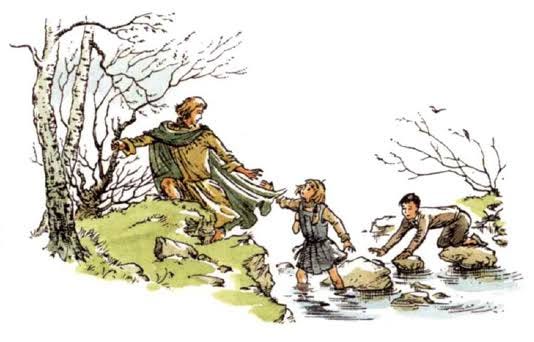
But Tirian cannot speak. Much as he wants to and much as he needs to, his voice, as often happens in dreams, makes no sound at all. The vision fades and he wakes still tied to the tree. But help is at hand: ‘Almost at once there came a bump, and then a second bump, and two children were standing before him.’
Eustace and Jill have arrived. Aslan, through the Friends of Narnia, has answered Tirian’s prayer and given him the help that he needs.
Eustace later tells Tirian that Digory and Polly had gathered the Friends together, ‘partly just for fun, so that we could all have a good jaw about Narnia (for of course there’s no one else we can ever talk to about things like that) but partly because the Professor had a feeling that we were somehow wanted over here. Well then you came in like a ghost or goodness knows what … After that, we knew for certain that something was up.’
There’s a lot contained in these seemingly throwaway lines, particularly the bracketed comment, ‘for of course there’s no one else we can ever talk to about things like that.’ It’s an aside, of course. Eustace is trying to play it down. He doesn’t want to make a big thing of it. But this is where the Friends of Narnia, whatever their faults with Susan and whatever their achievements in previous books, really earn their corn for me. Because he’s right. It isn’t the kind of thing you can casually toss into a random conversation. Your interlocutor has to be ready and able to receive the revelation, as Eustace himself discerned that Jill was at the start of The Silver Chair. But she was the last person outside of Narnia ever to be told, and Eustace is very stark and clear here - ‘there’s no one else we can ever talk to about things like that.’
This all makes me wonder just how difficult it might have been for them to keep faith in Narnia, especially with sceptics like Susan needling away. The intellectual climate of the time as well (the late 1940s) was dominated by scientism and rationalism. Marx and Freud held significant sway, and it must, I feel, have taken a focused effort on the part of the Friends to convince themselves that they weren’t engaged in an elaborate act of wish-fulfilment or some kind of collective compensatory delusion.
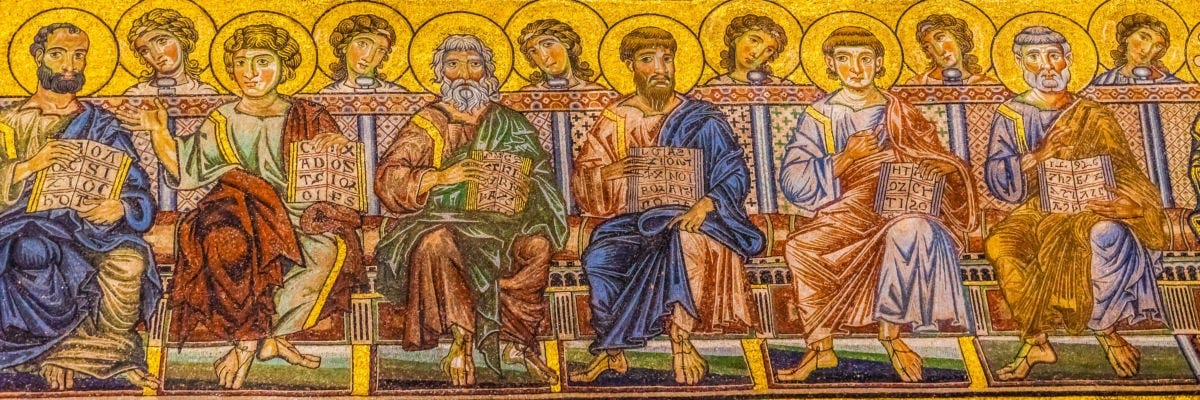
But there’s more going on than this, impressive though this is. There are deeper levels at work here, because what Tirian does on the tree is essentially call upon the Communion of Saints. Theologically speaking, he does everything correctly. He calls first of all on Aslan, and then says, ‘If you will not come yourself at least send me the helpers from beyond the world. Or let me call them. Let my voice carry beyond the world.’
Similarly, in our world, we don’t call upon the saints because they are gods. We call on them because they know and serve the true God and because they are his friends and helpers. Each of them, in their different ways, has overcome everything this world can throw at them and have passed through to the other side with their faith intact and shining. Paul Evdokimov, in his posthumously published, La Nouveauté de 'l’Esprit (1977), pins this down superbly:
The saints are our intercessors and protectors in the heavens, and therefore the most active members of the Church militant. They surround us with a cloud of witnesses and cover us with their prayers. They are not mediators between God and man - for the only Mediator is our Lord - but they are our friends, who pray for us, and help us in our spiritual life.
The Philanthropic God grants the saints the grace of active assistance. They constitute the invisible presence of the Church, like the hands of God, to carry out His economy of salvation. Before our Father, we stand together, and this is the “communion of saints.”
But still there’s more - like the ever-widening circles of reality that invite the characters ‘farther up and farther in’ in the final chapters. Because what starts to come through now is that we, the readers, are called to be saints ourselves - all of us - so that others can call on us in their turn. Evdokimov again:
According to Saint Paul, all are called to be saints, and each has his place in this chain or ‘golden belt’ of the Church. ‘There is only one sadness,’ said Léon Bloy, ‘and that is not to be a saint.’
The ‘whisky priest’ in Graham Greene’s The Power and The Glory (1940) can vouch very well for this:
He felt only an immense disappointment because he had to go to God empty-handed, with nothing done at all. It seemed to him, at that moment, that it would have been quite easy to have been a saint.
It is easy. That’s my gut sense. Easier than we think. Easier than we fear. ‘My yoke is easy,’ says the Lord, ‘and my burden light.’ All we need do is look up at Him and at his friends and helpers circling around Him. A great cloud of witnesses. As Plotinus reminds us, ‘We become that which we contemplate.’
And what we contemplate is the Communion of Saints - the Communion Sanctorum - and at the end of our own Last Battle, whenever that might be, and even now - especially now - it remains for all eternity the only place to be.
Just a quick note to thank you as ever for your support and remind you that my e-book, Guardians of Presence: Uncovering the Sacred in a Time of Deep Forgetting is available here.
You can also ‘Buy me a Coffee’ here ☕ 👍
Thanks again and have a great Mid-Summer / Mid-Winter wherever you may be in the world,
John (Secret Fire)