
Enter the Theo-Drama
C.S. Lewis's Cosmic Trilogy - Conclusion

In many ways, it isn’t in the spirit of The Cosmic Trilogy to offer a conclusion to this series or a summing-up. That’s because the books aren’t a closed-off sequence, and there are plenty of sequels that Lewis could have written if he had felt called to. That Hideous Strength ends with Ransom bidding farewell to his Company and preparing to board the vessel that will take him to Venus, where he will be with Arthur, Elijah, Enoch, and Melchisedec - men who did not taste death but were taken up to Heaven instead. Ransom will be healed there of the wound he incurred fighting the Un-Man, but what else he might do or whether he will return to Earth are left open questions. The story continues down here on Thulcandra though. The cycle of Pendragons goes on:
‘That old man was the seventy-eighth from Arthur: our Director received from him the office and the blessings; tomorrow we shall know, or tonight, who is to be the eightieth.’
We have been told as well that the forces behind the NICE will inevitably regroup and launch further assaults, so there’ll be plenty of work for the new Pendragon to do before long. This, to me, is one of the many great things about That Hideous Strength. You finish the book after a 382 page rollercoaster, yet it feels more like a beginning than an end. For those characters who have endured and won through, life appears to be starting anew. Take Mark and Jane Studdock, for instance, in the book’s concluding lines:
And Jane went out of the big house with the Director’s kiss upon her lips and his words in her ears, into the liquid light and supernatural warmth of the garden … First she thought of the Director, then she thought of Maleldil. Then she thought of her obedience and the setting of each foot before the other became a kind of sacrificial ceremony. And she thought of children, and of pain and death. And now she was half way to the lodge, and thought of Mark and of all his sufferings. When she came to the lodge she was surprised to see it all dark and the door shut … Then she noticed that the window, the bedroom window, was open. Clothes were piled on a chair inside the room so carelessly that they lay over the sill: the sleeve of a shirt - Mark’s shirt - even hung down the outside wall. And in all this damp too. How exactly like Mark! Obviously it was high time she went in.
The Cosmic Trilogy is a dramatic, dynamic suite of novels. There’s nothing static or fixed about it, and this makes it especially suitable if we’re feeling stuck in a rut or struggling with circumstances that seem impervious to change or growth. It’s also important to stress that the characters aren’t moved about like pieces on a chessboard that don’t have choice or volition. The whole narrative begins with a choice, when Ransom chooses to help Harry’s mother and promises to call at The Rise and ensure the boy is sent home. He may have been thinking primarily about the prospect of a night’s accomodation, but it was still an active decision on the side of the Good, and from this single deed a wonderful new direction and trajectory opens up.
A sterner challenge is met and overcome in Perelandra, where Ransom is compelled to see that arguments are insufficient and that he has to act, even violently, to preserve what’s good. The Green Lady’s role is similar in that Maleldil’s injunction to avoid the Fixed Land is not so much a command that she has to obey but rather a dramatic, developing situation that requires inner sifting, thought, and discrimination. If her obedience is mechanical or done merely by rote, then this isn’t the sort of response that Maleldil needs. Her obedience has to be free, personal, and acted out in time, like Mary’s Fiat at the start of St. Luke’s Gospel. Ransom gives her sound advice throughout, but in the end he does something so much more for her, something pure and Christ-like, in entering the arena physically on her behalf.
In That Hideous Strength we see the action transposed onto an institutional, civilisational level. The descent of the gods at the end, we might say, is a mythopoetic rendering of an eschatological, apocalyptic unveiling. History is not a closed shop, and the Most High can decisively and emphatically intervene at any point.
This maps on very well, I feel, to the concept of ‘Theo-Drama’ expounded by the Catholic theologian, Hans Urs Von Balthasar (1905-1988). This project, which Balthasar set out in a five-volume series between 1973 and 1983, revolves around the idea that God’s revelation unfolds as a divine-human drama, with freedom, conflict, roles, mission, and climax all centred on Christ, who is the pivot and fulcrum of history. God is the author of the drama, and He has a vested, personal interest in the outcome. He isn’t a remote, disinterested playwright or auteur. Human freedom in Balthasar’s schema is likewise real and risky. Our roles aren’t scripts that we simply recite. History is the stage on which this Theo-Drama plays out, and Christ is the active, luminous centre. In Him, divine and human freedom meet without tension or coercion. The action’s always moving forwards too towards a just and fitting conclusion. False powers (like the NICE) will be exposed, counterfeit meanings will collapse, and judgment come down on us in a moment of truth and choice that will reveal the true nature of our souls.
This is an illuminating and instructive lens through which we can view The Cosmic Trilogy, where reality is the opposite of an abstract, blank canvas. It’s a real-time theatre where salvation and damnation are live possibilities at every instant. Freedom, for Lewis, isn’t about ‘doing what we want.’ It’s about discerning and acting out the particular role that we’re best fitted for in the ongoing Theo-Drama. We sin when we see what that role is and recognise that it’s what God’s given us, yet refuse it because we think we can come up with something better ourselves. God knows how many times I’ve done this myself! The adventure of obedience is rejected because our ego rebels against it and sees in it something oppressive and limiting. Ransom, in That Hideous Strength, shows and explains to Jane the participatory joy that comes with true obedience and co-operation with the deep, universal pattern:
They talked of the book a little while the Director ate and drank; but presently he took up the plate and tipped the crumbs off onto the floor. ‘Now, Mrs. Studdock,’ he said, ‘you shall see a diversion. But you must be perfectly still.’ With these words he took from his pocket a little silver whistle and blew a note on it. And Jane sat still till the room became filled with silence like a solid thing and there was first a scratching and then a rustling and presently she saw three plump mice working their passage across what was to them the thick undergrowth of the carpet … With quick, inaudible movements they ranged to and fro till not a crumb was left on the floor. Then he blew a second time on his whistle and with a sudden whisk of tails all three of them were racing for home and in a few seconds had disappeared behind the coal box. The Director looked at her with laughter in his eyes … ‘There,’ he said, ‘a very simple adjustment. Humans want crumbs removed; mice are anxious to remove them. It ought never to have been a cause of war. But you see that obedience and rule are more like a dance than a drill - specially between man and woman where the roles are always changing.’
To round this series off, I’d simply say that reading The Cosmic Trilogy is always a life-changing, life-enhancing experience, but particularly so if the wheels have stopped turning in your life and you’re feeling that there’s no future to look forward to that’s any different or better than what you’re going through now. Please, I implore you, don’t invest any more in this negative, defeatist mode of thinking. I know what it’s like because I’ve been there myself. Please stop, and read and reflect on these books instead, and look at how Ransom, through his co-operation and partnership with Maleldil, becomes such a radically different person. This is Lewis the narrator’s first impression of him upon his return from Perelandra:
I was silent for a moment, astonished at the form which had risen from that narrow house - almost a new Ransom, glowing with health and rounded with muscle and seemingly ten years younger. In the old days he had been beginning to show a few grey hairs; but now the beard which swept his chest was pure gold.
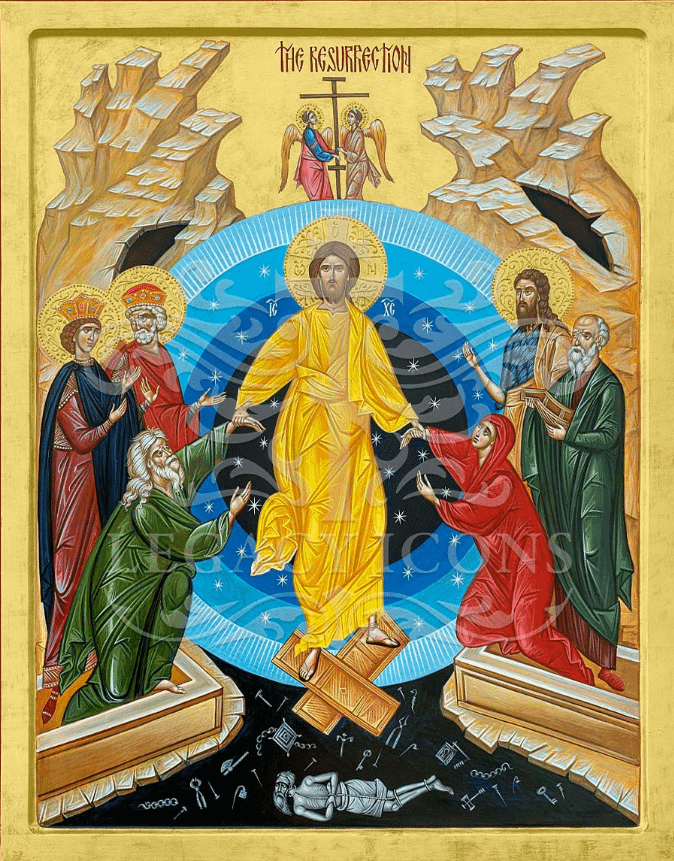
That’s the nub of it all really. The Theo-Drama isn’t just drama for drama’s sake. It matters profoundly, more than anything else in the world. Only God knows the full scope and scale of the cosmic play He has devised and set in motion. Christ is the central character, the still point of the turning world. But the dramatic tension concerns ourselves and what we do and think and feel and say right this minute in the here and now. How well are we playing these roles we’ve been given to help Christ out in his fight against evil? Will we accept them or will be lured over, maybe without even being conscious of it, to the side of the adversary? Are we beside the Lord when He beats down the gates of Hades - an act that occurs not only on Holy Saturday but at all times and places in a million different ways - or have we gone missing in action, deceived and deluded by the Bent One’s false promises?
Whatever our role, even if we’re not singled out like Ransom but asked to remain humbly where we are, as with the Company at St. Anne’s, it’s the role that Maleldil has given us and the role that He knows, in His infinite wisdom, is best for us, and by extension the whole wide world and cosmos. To have the faith and humility and generosity of spirit to accept this role, this station, this limitation, and rejoice in it is truly, I think, the pearl of great price.
I’m a long way off this level of humility and grace, if I’m honest, but there’s no point dwelling on such things because there’s simply no time or space in The Cosmic Trilogy - which is ‘real life’ at its most concrete and tangible - to be depressed, anxious, or preoccupied. There’s too much going on and too much at stake, and that’s the end of it. And the beginning, of course!
So, looping back to the beginning, I’ll finish with a few words from the Introduction to this series:
What Lewis offers here is heroic theology - no sympathy, no ‘poor me’, no sentimentality - a mythopoetic world that’s at once tragic, radiant and terrible. More real than the ‘real world’, tougher and more substantial. He calls us up and out towards a purified core of faith and imagination, to the noble and virtuous fight for meaning, purpose, and value.
The answer to despair is neither cynicism on the one hand nor comfort on the other. It’s transfiguration - always, all the time - and that’s what these books are about.
If you’ve found value in this piece and series, then I’d encourage you if you can please to 'buy me a coffee'. Any and all contributions make a huge difference, and they’ll help me no end in completing the first Secret Fire e-book, which I’m hoping to have ready for this time next month. Thank you and all the very best, John ☕
Thankyou this spoke to me today. It’s many years since I read these books and I must go back to them .’ Freedom …. Is about discerning and acting out the particular role we’re best fitted for …….